
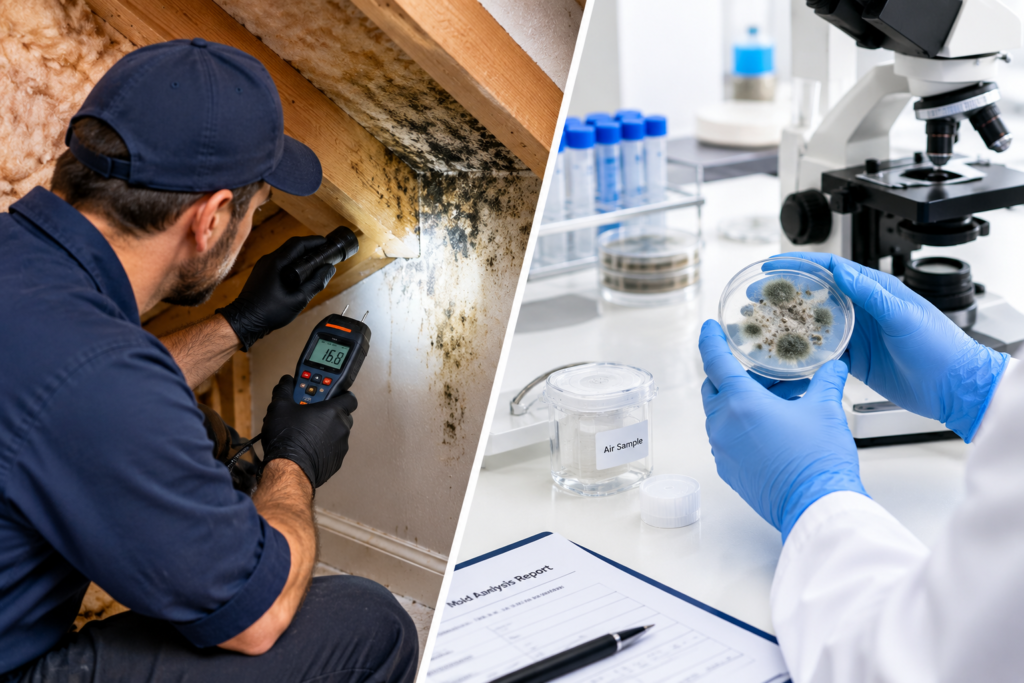
If you’ve searched for help with a possible mold problem in your Fort Worth home, you’ve probably run into both terms – “mold testing” and “mold inspection” – used almost interchangeably. They’re not the same thing, and picking the wrong one can mean paying for a service that doesn’t actually answer the question you’re asking. Here’s a clear breakdown of what each one does, when you need one versus the other, and how they work together.
The Short Answer
A mold inspection is a visual, physical investigation of your property to find visible mold, moisture sources, and conditions that could be causing hidden growth. A mold test (also called sampling or air quality testing) uses lab analysis – of air, surfaces, or materials – to identify what type of mold is present and at what concentration, especially when nothing is visible but you suspect a problem.
In plain terms: an inspection answers “is there a problem, and where?” A test answers “exactly what is it, and how bad is it?” Most legitimate mold situations start with one and only move to the other if needed.
What a Mold Inspection Actually Involves
A professional mold inspection is a hands-on walkthrough of your property by a trained technician. It typically includes:
- Visual assessment of areas prone to moisture – attics, basements, crawl spaces, under sinks, around windows, and HVAC systems
- Moisture mapping using moisture meters and sometimes thermal imaging to find damp areas behind walls or under flooring that aren’t visible to the eye
- Odor and visible growth documentation – musty smells and discoloration are strong indicators even before any lab work happens
- Source identification – figuring out why mold is growing (a roof leak, poor ventilation, plumbing issue, or high humidity) rather than just noting that it exists
An inspection is usually the right first step any time you can see mold, smell mustiness, have had recent water damage, or are buying/selling a home and want a pre-purchase or pre-listing assessment. It’s also considerably less expensive than lab-based testing, since it doesn’t involve sample analysis fees.
What Mold Testing Actually Involves
Mold and indoor air quality testing goes a step further by collecting physical samples for lab analysis. Depending on the situation, this can include:
- Air sampling – measuring mold spore concentration in the air, often compared to an outdoor baseline sample to determine whether indoor levels are abnormal
- Surface sampling (swab or tape lift) – identifying the exact species of mold on a visible growth
- Bulk sampling – testing a piece of material (drywall, insulation, carpet) suspected of harboring mold
- Post-remediation clearance testing – confirming that a remediation job actually worked and the property is safe to reoccupy
Testing is the right call when there’s no visible mold but you’re experiencing symptoms (allergy-like reactions, respiratory irritation, persistent musty odor), when you need documentation for insurance or a real estate transaction, or when you need to verify that remediation work was successful – since you genuinely cannot confirm clearance visually.
Mold Testing vs. Mold Inspection: Side-by-Side
| Mold Inspection | Mold Testing | |
|---|---|---|
| What it does | Visual + moisture assessment | Lab-analyzed samples |
| Best for | Visible mold, musty odor, water damage history | No visible mold but symptoms present, or verification needed |
| Typical cost | Lower — no lab fees | Higher — includes sample analysis |
| Turnaround | Same-day findings | Days, pending lab results |
| Gives you | Where the problem is and why | What it is and how much |
Do You Need Both?
Often, yes – but in sequence, not simultaneously by default. The typical, cost-effective path looks like this:
- Start with an inspection. A technician walks the property, identifies visible growth and moisture sources, and in many cases can make a confident recommendation without lab work at all — especially if mold is clearly visible and the source is obvious (like a known roof leak).
- Add testing only if needed. If there’s no visible mold but you have symptoms, if the inspector needs to identify a specific species for health or legal reasons, or if you need documented proof for insurance, testing is added at that point.
- Always test after remediation. Whether or not testing was used upfront, post-remediation clearance testing is the only reliable way to confirm mold spore counts have returned to normal and the remediation actually worked – visually, a clean-looking room can still have elevated spore counts.
Jumping straight to expensive lab testing when an inspection would answer your question is one of the most common ways homeowners overpay. On the other hand, skipping testing entirely when there’s no visible mold but ongoing health symptoms can leave a real problem undocumented and untreated.
Common Situations and What They Call For
“I can see black spots on my bathroom ceiling.” Start with an inspection – the visible growth combined with a moisture source (usually poor ventilation) is often enough to move straight to remediation. Learn more about what’s typically involved in black mold removal in Fort Worth.
“There’s a musty smell in the basement but I don’t see anything.” Inspection first, with air sampling likely recommended if the moisture mapping doesn’t turn up an obvious visible source. This is also a common scenario for basement mold cleanup situations.
“We had a pipe leak in the attic a few months ago.” Inspection is essential here even without symptoms – hidden attic moisture is one of the most common sources of mold that goes undetected for months. See our attic mold remediation page for what that process looks like.
“We’re buying/selling a home.” A pre-purchase or pre-listing inspection, sometimes paired with clearance-level testing depending on the buyer’s or lender’s requirements.
“We just finished remediation – how do we know it worked?” Post-remediation clearance testing, every time. This is documented through our post-remediation verification service and is the only way to confirm the job is actually complete.
Why This Distinction Matters for Fort Worth Homes
Tarrant County’s humidity swings – hot, muggy summers followed by wetter stretches in spring — create ideal conditions for both visible growth and hidden moisture pockets in attics, crawl spaces, and older HVAC systems. That combination is exactly why starting with the right service matters: an inspection that catches a moisture source early can prevent a $300 problem from becoming a $5,000 remediation and testing needed for widespread growth.
If you’re not sure which one your situation calls for, that’s a normal question to have – a quick phone conversation about what you’re seeing or smelling is usually enough for a technician to recommend the right starting point rather than upselling you into testing you don’t need yet.
Getting Started
If you’re dealing with visible mold, a musty odor, recent water damage, or unexplained allergy-like symptoms anywhere in the Fort Worth or Tarrant County area, our team can help you figure out whether you need an inspection, testing, or both – based on what you’re actually experiencing, not a one-size-fits-all package. We also serve surrounding communities; see our full list of areas served to confirm coverage near you.
Frequently Asked Questions
Can I just do a visual inspection myself and skip the professional service? You can look for obvious signs yourself, but a professional inspection finds hidden moisture behind walls and under flooring using tools like moisture meters and thermal cameras that aren’t available to most homeowners – and correctly identifying the source, not just the visible growth, is what prevents the problem from coming back.
Is mold testing required by law before remediation? Not generally for routine residential remediation, though some real estate transactions, landlord-tenant disputes, or insurance claims may require documented test results.
How long does testing take to get results? Air and surface sample lab results typically take a few business days, while a visual inspection gives you findings the same day.
Does insurance cover mold testing or inspection costs? It depends on your policy and whether the mold resulted from a covered peril, like a sudden pipe leak versus long-term humidity. Documentation from a professional inspection or test often plays a role in how a claim gets evaluated.
Not sure whether your situation calls for an inspection, testing, or both? Contact Fort Worth Mold Remediation for a straightforward recommendation based on what you’re seeing in your home.
Leave a Reply